Falloff map
The Falloff Map texture controls material blending, depending on the viewing angle of the material's geometry (figure 2).
|
|
Falloff Map
|
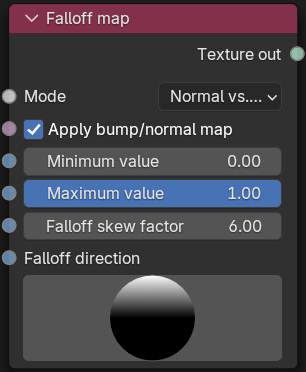
Figure 1: Falloff map Node
|
|
Falloff Map
|
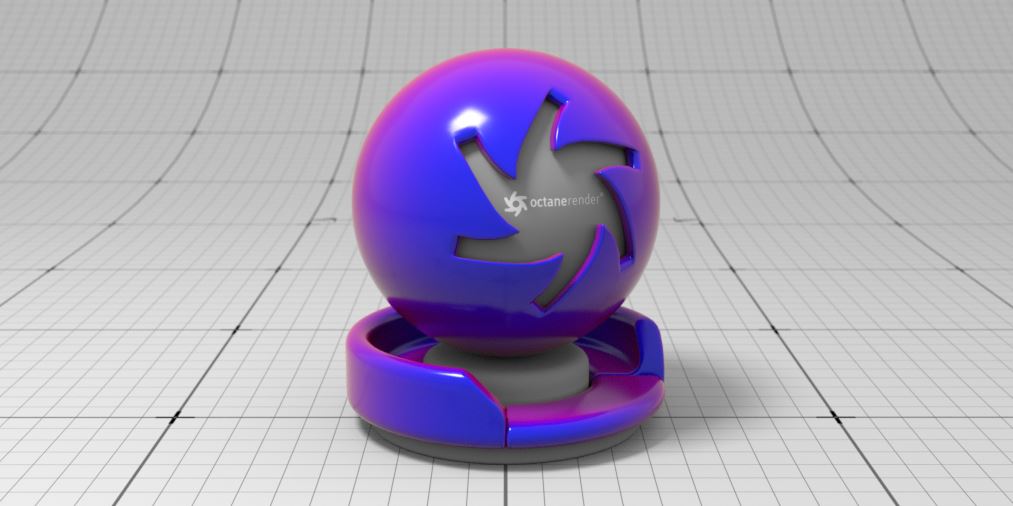
Figure 2: A Falloff Map node example
Falloff Map Parameters
Modes - The angle between the eye ray and the shading normal is mapped from (0, 90) to (0, 1). For values larger than 1, the Falloff node does a gamma correction by using the Falloff Skew Factor as an exponent. Falloff Skew Factor interpolates between the spectral shades resulting from the Minimum and Maximum values, which are based on the first and second inputs of a mixed Node.
There are three modes of the Falloff Map:
- Normal vs. Eye Ray - This is the default mode where OctaneRender® calculates the falloff from the angle between the Surface Normal and the Eye Ray. This mode is often used for reflections. The Falloff color range affects faces directly in front of the view, and gradually falls at angled faces towards the sides as it falls away from the straight-on viewing angle. The Falloff Direction parameter does not apply.
- Normal vs. Vector 90deg - OctaneRender® calculates the falloff from the angle between the Surface Normal and the specified direction vector, maxing out at 90 degrees. This is similar to the default mode, except that it maintains the effect of the color range according to the Falloff Direction parameter.
- Normal vs. Vector 180deg - OctaneRender® calculates the falloff from the angle between the Surface Normal and the specified direction vector, maxing out at 180 degrees. This provides a wider color range from the minimum to the maximum values, and maintains the effect of the color range according to the Falloff Direction parameter.
Apply bump/normal map - If enabled, the shading normal, which includes bump/normal mapping, will be used to calculate the falloff. If disabled, the smooth normal which does not include bump/normal mapping, will be used instead.
Minimum Value - The visible material on the surface facing the camera. A value of 0 displays the material connected to Material pin 2, and a value of 1 displays the material connected to Material pin 1.
Maximum Value - Determines what material displays towards the grazing angles. A value of 0 displays the material connected to Material pin 2, and a value of 1 displays the material connected to Material pin 1.
Falloff Skew Factor - Balances the Normal and Grazing angles' influence. Low values result in stronger Grazing angle influence - any textures that the Maximum Value controls cover more surface. High values result in stronger Normal angle influence - any textures that the Minimum Value controls cover more surface.
Falloff Direction - This is used by the Normal vs. Vector 90deg and Normal vs. Vector 180deg modes. For most materials, the Fresnel effect (the default mode) is often correct, while Falloff Direction applies for exceptional cases, which can adjust relative to the camera. Changing the object rotation will not change the Falloff Direction orientation.
|
|
Falloff Direction
|
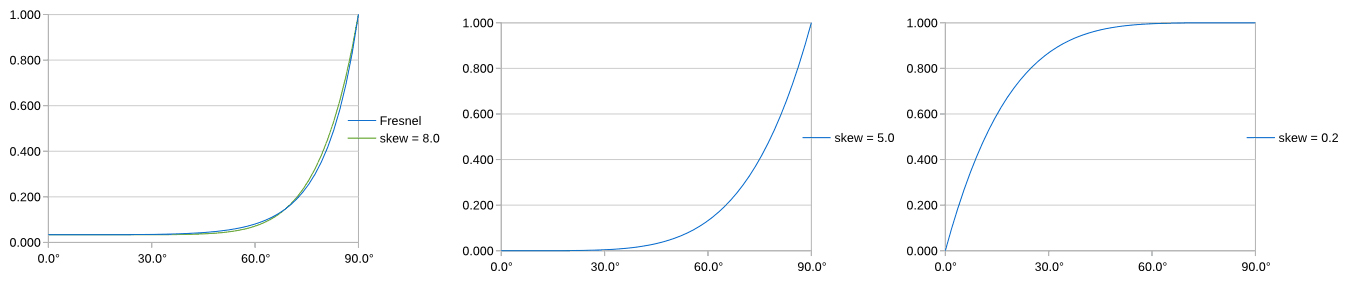
Figure 3: Falloff Direction curves
You can also use the Falloff Map for other things, like the input for glass opacity. Falloff is useful for car shaders, water shaders, and fabrics like velvet. It is also useful for some metals to simulate some coating effects (figure 4).
|
|
Falloff Examples
|
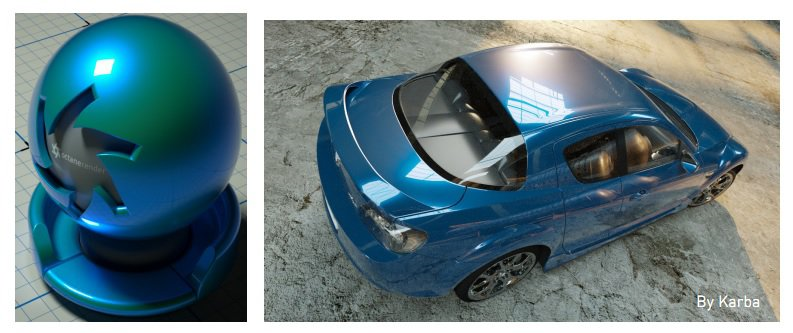
Figure 7: Car shader example