Texture Emission
The Texture emission allows any valid texture node to set the light intensity (figure 1). This can be used to create interesting effects, such as TV screens, by using an image texture as the source.
|
|
Texture Emission
|

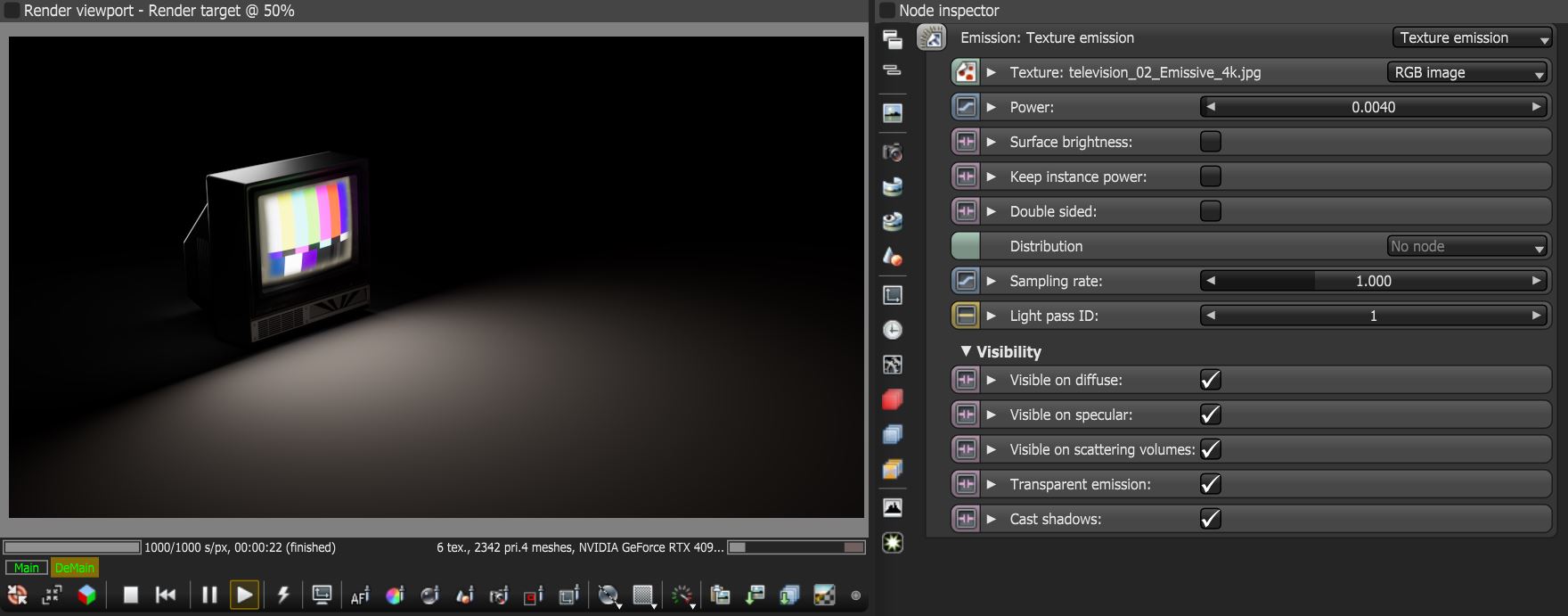
Figure 1: A Texture Emission node connected to the Emission pin on a Diffuse material
Texture Emission Parameters
Texture - Sets the light source's efficiency. You can set this to a value or texture. Keep in mind that real-world lights aren't 100% efficient at delivering power at their specified wattage - a 100-watt light bulb doesn't deliver 100 watts of light. This parameter enters the real-world values.
Power - The light source's wattage. You should set each light to their real-world wattage - for example, set a desk lamp to 25 watts, a ceiling lamp to 100 watts, and an LED light to 0.25 watts.
Surface Brightness - Causes emitters to keep a constant Surface Brightness, independent of the emitter surface area.
Keep Instance Power - Enabling this option with Surface Brightness disabled and Uniform Scaling applied to the object causes Power to remain constant.
Double Sided - Allows emitters to emit light from the front and back sides.
Distribution - Controls the light pattern. This can be set to a Greyscale or RGB image for loading an image texture or IES file. the image texture's Projection nodes adjust the light's orientation and direction.
Sampling Rate - Choose what light sources receive more samples.
Light Pass ID - The Light Pass ID captures the respective emitter's contribution.
Visible On Diffuse - Enables light source visibility on diffuse surfaces. It enables Black Body or Texture emission light sources to cast illumination or shadows on diffuse objects. Disabling this option disables emission - it's invisible in diffuse reflections, but is still visible on specular reflections. It's also excluded from the Direct light calculation. This option is enabled by default.
Visible On Specular - Enables the light source's visibility on specular surfaces, and hides emitters on specular reflections/refractions. This is enabled by default.
Visible on Scattering Volumes - If enabled, the illumination is visible on scattering volumes.
Transparent Emission - Light sources cast illuminations, even if the light source is on transparent material. If unchecked, a transparent surface will "glow" but not cast illumination into the scene.
Cast Shadows - Enables surfaces within the illumination of the light source to cast shadows. If disabled, the light source will illuminate surfaces but the surfaces will not cast a shadow from the light source.